About 3,000 years ago, an ancient people in Mexico carved giant stone heads and hauled them across the land without wheels or pack animals.
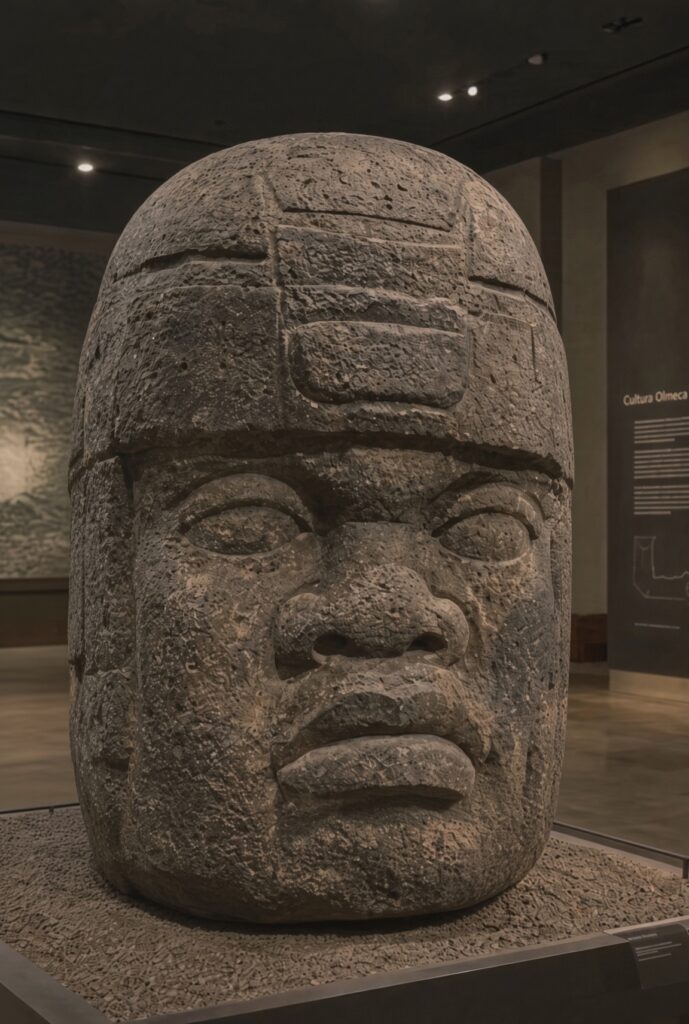
These are the Olmec colossal heads.
They still raise two big questions: how were they moved, and whose faces are they?
Who were the Olmec?
The Olmec lived along Mexico’s Gulf Coast, in today’s states of Veracruz and Tabasco.
They flourished from about 1200 BC to 400 BC and built some of the earliest cities in the region, including San Lorenzo, La Venta and Tres Zapotes.
Most of the heads were carved early in that period.
At San Lorenzo, they had been buried by around 900 BC, and they stayed hidden until the first one was rediscovered in 1871.
Seventeen Faces, Each One Different
Archaeologists have found 17 heads so far: 10 at San Lorenzo, four at La Venta, two at Tres Zapotes and one at La Cobata. The smallest weighs about 6 tons, and the largest about 40.
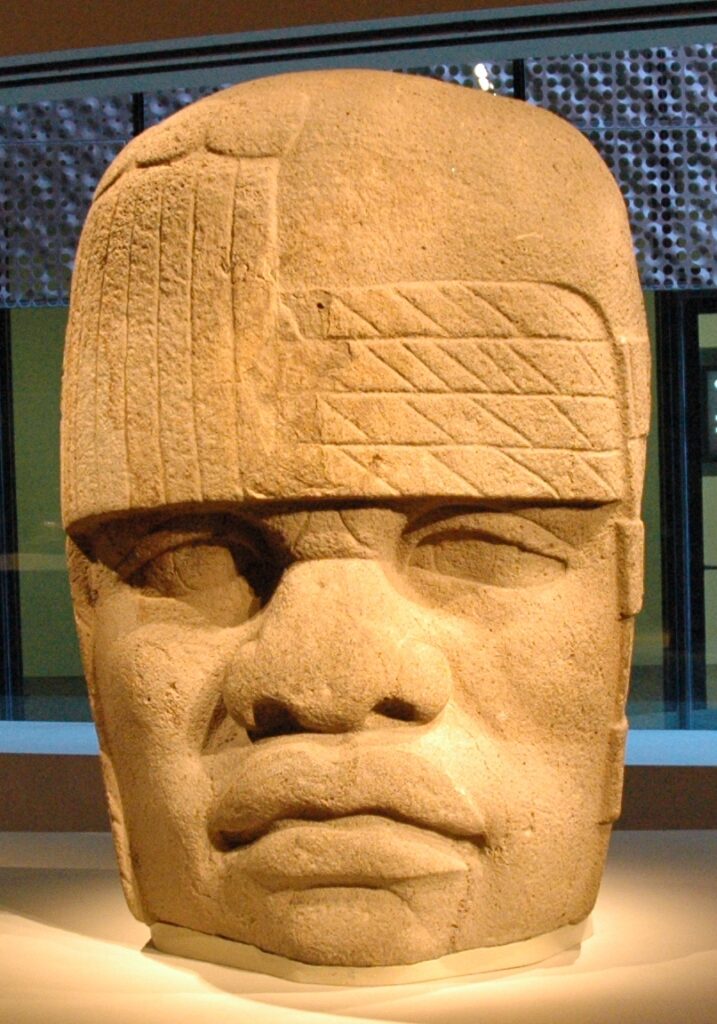
No two faces are alike, and each wears its own helmet-like headdress.
That’s why most experts believe they are portraits of real Olmec rulers.
A Journey of More than 60 miles
The heads are made of basalt, a hard volcanic rock.
Most of it came from Cerro Cintepec, a volcano in the Tuxtla Mountains, more than 60 miles from the cities where the heads were set up.
Exactly how the boulders made that trip is still unknown. The leading theory is that workers dragged them over land on log rollers and floated them along rivers on large rafts.
Olmec art may offer a clue. Two damaged carvings appear to show stone blocks tied with ropes, possibly with rulers watching over the work.
From Throne to Face
Not every head started as a fresh boulder.
At least two from San Lorenzo, Heads 2 and 7, were reworked from giant stone thrones, and Head 7 still has a deep hollow on one side from its earlier life.
Other unfinished pieces seem to have been abandoned partway through the same change. Many heads also have flat backs, which may be another sign they began as thrones.
Art historian Mary Ellen Miller has suggested why. When a ruler died, his throne may have been recarved into his portrait, so the stone he once sat on became his face.
Where to See them Today
All 17 heads are still in Mexico.
Seven are at the Xalapa Museum of Anthropology in Veracruz, two at the National Museum of Anthropology in Mexico City and four in Villahermosa, Tabasco.
The rest stand in small museums and town plazas near where they were found.
Three thousand years later, the heads still keep their biggest secret.
We know an ancient people moved them by hand. We just don’t know exactly how.