

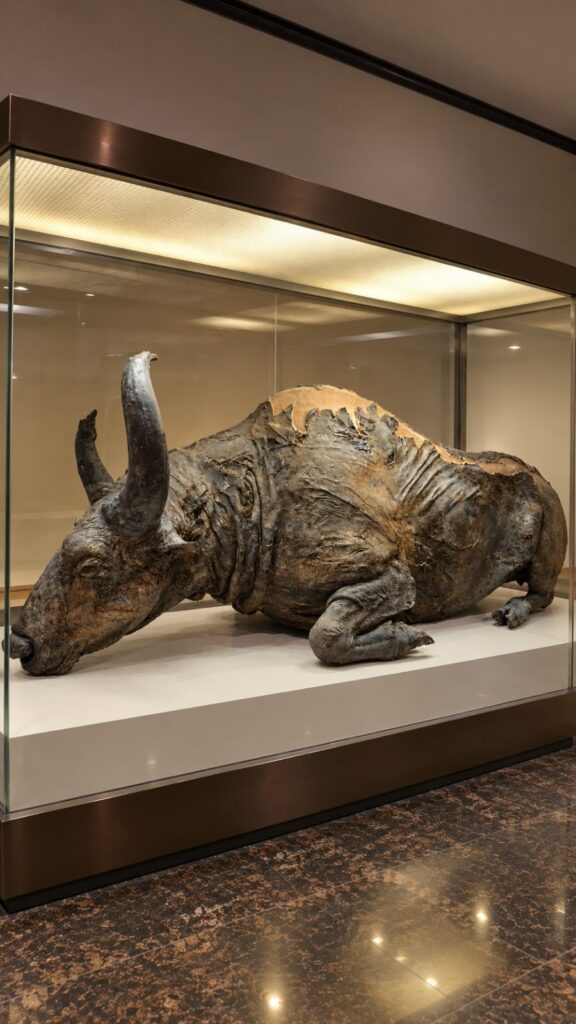
In 1984, a group of scientists in Alaska sat down to a bowl of stew made from an animal that died during the Ice Age.
The meat came from Blue Babe, a frozen bison so well preserved that its skin still carried the wounds of the lion that killed it.
Found by Gold Miners
In 1979, gold miners Walter and Ruth Roman and their sons were working near Fairbanks, Alaska.
As they blasted frozen mud with a hydraulic hose, part of a frozen carcass appeared in the bank. They called the University of Alaska.
Paleontologist Dale Guthrie led the excavation and identified the animal as a steppe bison, a long-horned relative of today’s bison that roamed the north during the Ice Age.
Digging it out wasn’t easy. The carcass hung from the frozen bank by its head and neck, so Guthrie’s team moved the thawed parts to the university and refroze them to stop them from rotting.
A Blue Bison and a Lion Attack
As the carcass was exposed, a white mineral coating on its skin turned bright blue in the air.
The coating was vivianite, which forms when phosphorus from an animal’s body reacts with iron in the soil. The scientists named the bison Blue Babe, after Babe, the giant blue ox of Paul Bunyan legend.
The body also revealed how it died.
Claw marks on its rear and tooth punctures in its skin, some still holding clotted blood, pointed to an Ice Age American lion.
The bison probably died in fall or winter, and the carcass froze so quickly that scavengers couldn’t finish it.
How Old is it?
In the 1980s, radiocarbon dating of its skin showed Blue Babe died about 36,000 years ago.
Some later reports put its age closer to 50,000 years, and the university’s Museum of the North says newer, more precise dating could push the estimate older.
For now, 36,000 years is the long-standing official figure.
Dinner is Served
In 1984, once Blue Babe had been prepared for display, Guthrie hosted a dinner party at his home.
On the menu was a stew made from a small piece of the bison’s neck, diced and simmered with stock and vegetables.
Guthrie later described the meat as “well aged but still a little tough,” giving the stew a “strong Pleistocene aroma.”
He said it smelled like beef and tasted delicious, and that “none of us suffered any ill effects.” His wife, Mary Lee, was less impressed and reportedly said it was worse than beef jerky.
Where Blue Babe is Today
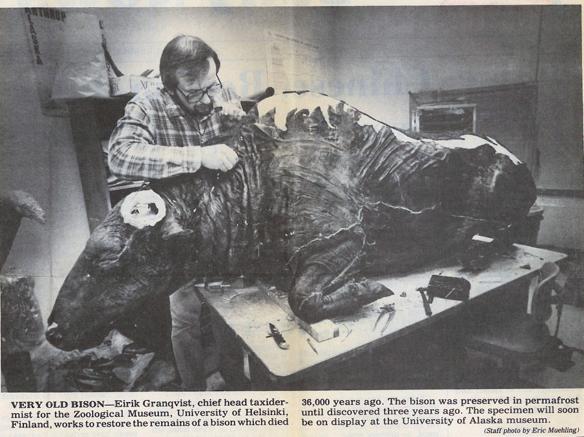
Finnish taxidermist Eirik Granqvist restored the bison, tanning its skin and building it a new body to rest on.
Since 1984, Blue Babe has been on display at the University of Alaska Museum of the North in Fairbanks. The museum says it’s the only Ice Age bison recovered from permafrost on display anywhere in the world.
It survived an Ice Age lion, tens of thousands of years in frozen ground, and a hydraulic hose.
Few museum pieces can also say they were part of dinner.


